
AP Chemistry
Online for the 2026-2027 School Year
Teacher: Peter Moskaluk
Email: moskaluk@chemadvantage.com
Email: moskaluk@chemadvantage.com
You are not currently logged in.
You must log-in/sign-up before you can pay tuition for a course.
Log-in/Sign-up to RegisterREGISTRATION ENDS SEPTEMBER 7
Tuition: $925
Included with tuition: Digital version of Raymond Chang’s Chemistry textbook and a subscription to Cengage’s WebAssign®
Optional hard copy: Students who want a printed textbook may purchase any edition of Raymond Chang’s Chemistry (5th–14th). Differences between editions are minor, so any edition works equally well. Families can choose based on price.
Eligibility: Students in grades 9–12, ages 14–18, who have completed Algebra II. While many students enter the course having completed high school chemistry, motivated students without prior chemistry succeed as well. At the start of each new topic, I review the basics so students who are new to chemistry are not at a disadvantage.
Schedule: My AP® Chemistry course runs from August 24, 2026 to May 6, 2027 (AP Chemistry Exam) and follows a 36‑week curriculum with a four‑week AP® Exam review. Five weeks of scheduled breaks are built into the calendar, but families may adjust the dates to match their vacation plans, celebrations, and observances.
Registration: Enroll through AP® Homeschoolers by paying the tuition. After your payment is submitted, please complete my Student Registration Form to finalize your enrollment.
Supplies:
- One 1½-inch 3‑ring binder
- One 3-inch 3‑ring binder
- One set of 20 blank divider tabs
- One 100‑sheet composition notebook with sewn binding (lab notebook)
- Graphing or scientific calculator
- Quality Science Labs Advanced MicroChem Kit
Quality Science Labs is offering a 10% discount to my students during the 2026–2027 enrollment period. Contact me for the discount code before you purchase the kit. If you have already purchased the kit at full price, contact me and I will explain how to request a partial refund.
Siblings only need one kit. There’s enough material to repeat every experiment, so they can work independently or as a team.
Students who cannot obtain a lab kit will still be able to complete the required lab work.
Course Format: This AP® Chemistry course is the equivalent of a rigorous first‑year college chemistry sequence, including both lecture instruction and laboratory work. The course follows a clear weekly pacing guide that helps students stay on track while still offering the flexibility to work ahead and adjust for illness, travel, competitions, or other commitments. Although the course is asynchronous, students are never on their own. I’m available throughout the week to offer prompt, individualized support. Students describe the course as challenging yet well‑organized, engaging, and manageable. You can read student reviews at the bottom of this page.
Workload: Students should expect to spend about 2 hours per day during the school week on regular assignments. During lab weeks, students will need an additional 2–3 hours, and many prefer to complete the labs on weekends or on days when they have more time. Lab due dates are flexible, so students can plan their lab work around their schedules. Students do not need to complete any pre‑work before starting this course, and I never assign busy work.
Learning System: Students learn through comprehensive study guides, advanced problem sets, and clear classroom‑style video lessons for every topic. Step‑by‑step AP®‑style problem‑solving videos reinforce key skills and exam strategies. Optional weekly live sessions allow students to check their understanding as they move through the material. The course also includes an organic chemistry unit that supports several AP® Chemistry Exam topics and provides a strong head start for college organic chemistry. Students work with College Board AP® Classroom practice questions and progress checks as part of their preparation.
Labs: Students using the QSL Advanced MicroChem Kit perform the experiments and collect their own data. Students who cannot obtain a lab kit complete guided virtual labs by watching me perform each experiment while they record the resulting data. After that, everyone follows the same steps. Students analyze the data using spreadsheets and graphing software, perform the required calculations, and complete a corresponding online assignment that is evaluated immediately rather than waiting for hand‑grading. Students maintain a formal lab notebook following college‑level protocols. Details about the QSL kit and virtual labs are on the Lab Program page behind the AP® Chemistry tab at chemadvantage.net.
WebAssign®: I deliver the online coursework through Cengage’s WebAssign®, a platform widely used in college chemistry courses. I fully customize every assignment so students receive multiple submissions, helpful hints, and step‑by‑step explanations as they work through each problem. WebAssign® automatically grades the assignments, tests, and lab results, giving students instant feedback. The platform also provides an up‑to‑date gradebook that students and parents can check anytime for a clear picture of progress.
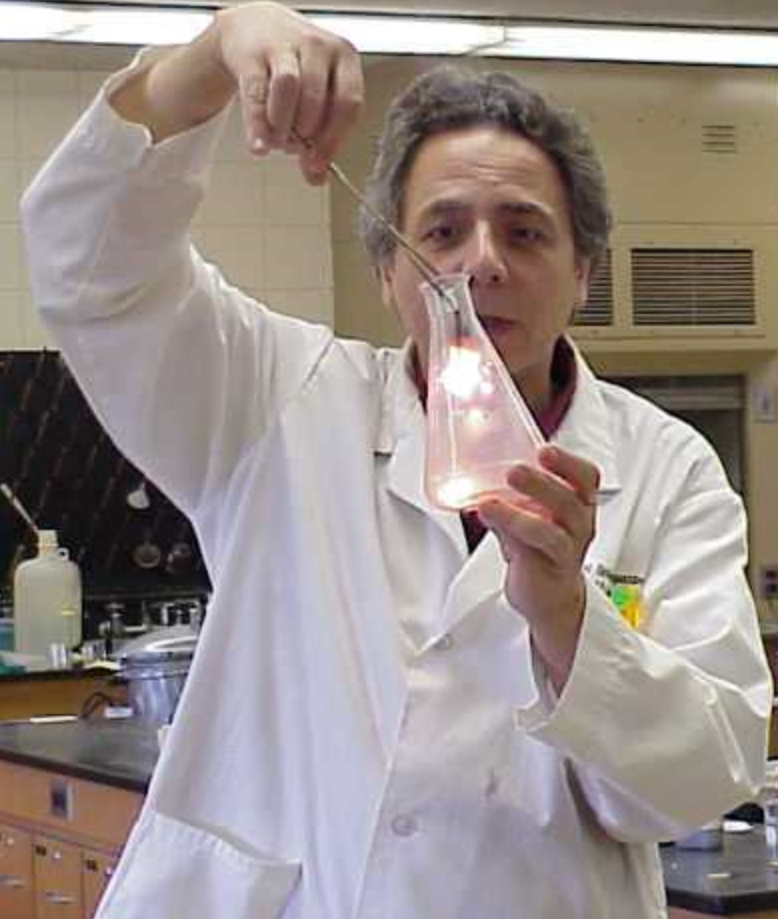
Live Sessions: I hold an optional 1-hour live session each week to go through the current topics, clarify challenging concepts, and solve chemistry problems step by step. Many sessions include lab demonstrations to show the chemistry in action. To accommodate different schedules, the day and time rotate between Monday and Tuesday at one of the following start times—12:00, 1:00, 2:00, or 3:00 PM ET. I record every session, so students can watch or review anytime, and nothing unique to the sessions is ever assessed on assignments or tests.
Discussion Board: Students receive personalized help through my Discussion Board. I monitor the forum throughout the day on weekdays and check in on weekends, so students have timely support. As part of my explanations, I incorporate annotations, diagrams, images, and videos to support student understanding. I also have several TAs, each of whom earned an A+ in the course and a 5 on the AP® exam. They answer questions enthusiastically and bring insights that only recent AP® Exam takers can provide. The Discussion Board is much more than a help desk. Students get to know one another, encourage each other, and help maintain a supportive environment for asking and answering chemistry questions.
Exam Preparation: I carefully pace the course, so students begin working with AP‑level assignments and tests early in the year, building familiarity with the style and expectations of the exam. I reserve four weeks for focused AP® Exam review, during which students work exclusively with previously released College Board AP® Chemistry exams. This gives them extensive practice with authentic AP® questions before test day.
Assessments: I evaluate students through a combination of assignments, tests, lab work, and a final exam that reflects the expectations of a first‑year college chemistry course. Each of the four graded components is worth a set number of points, and a student’s score is based on total points earned out of total points possible. The grading scale is available under Course Documents on the bottom navigation bar at chemadvantage.net.
- Assignments: Each unit includes assignments that help students build understanding through supported practice. Students receive multiple submissions, immediate feedback, and explanations of missed problems, so they can learn from mistakes and strengthen their understanding.
- Unit Tests: Tests include both multiple-choice and free-response questions modeled on the AP® Chemistry Exam. WebAssign® handles grading for most questions, and students self-score a set of free-response answers using a detailed guide. I review their work and answers as part of the process, so they learn how AP scoring works firsthand.
- Lab Results: Students submit their data, observations, and calculations through WebAssign® for instant grading.
- Final Exam: The final exam consists of AP® Chemistry exams released by the College Board and follows the same grading process used for the unit tests.
Grade Reports: I provide detailed mid-year and end-of-year grade reports for every student. The end-of-year report includes semester grades, final exam grade, final course grade, and organized summaries of assignments, tests, and labs. A sample grade report is available under Course Documents on the bottom navigation bar at chemadvantage.net.
Student Outcomes: In 2026, 75% of my AP® Chemistry students earned a score of 4 or 5 on the AP® Chemistry Exam, with 5 being the most common score. Over the years, my students have consistently earned AP® Chemistry Exam scores well above the international average. They have gone on to colleges and universities around the world, including all the U.S. Military Academies, Harvard, Yale, Princeton, Cornell, MIT, Georgia Tech, Bryn Mawr, Rutgers, Oxford University, the National University of Singapore, and many top U.S. state universities. Many have also won awards in ACS Chemistry Olympiad competitions.
Recommendation Letters: Throughout the year, I get to know students by their work, questions, and participation, allowing me to write detailed, personalized letters of recommendation for college applications, scholarships, and summer programs.
Instructor Qualifications: I have devoted my entire professional career to teaching chemistry and helping students master this challenging subject with confidence and proficiency. I am a Michigan‑certified chemistry teacher who taught Honors and AP® Chemistry for more than 35 years in the Grosse Pointe Public School System. During my last five years in public school, I began teaching AP® Chemistry for Pennsylvania Homeschoolers, where I have now taught for 18 years. My work has been recognized at the national level. I received the Presidential Scholars Teacher Recognition Award, a national honor given to only one hundred teachers each year. I have also worked with the National Science Foundation and participated in multiple NSF‑sponsored teacher programs. The Camille and Henry Dreyfus Foundation sponsored me as a Woodrow Wilson Fellow at Princeton University, where I lectured and collaborated with leading educators and scientists. My work with scientific organizations and university programs reflects a long‑standing commitment to advancing chemistry education. Over the course of my career, I have taught thousands of students and mentored new chemistry teachers.
My experience extends beyond the classroom. I have led workshops across the country for chemistry teachers and developed instructional software for chemistry. I hosted CHYMNET, an international online conference for chemistry educators. I have written assessment questions for the Michigan Educational Assessment Test and the ACT® Assessment. I have reviewed chemistry questions for Cengage’s WebAssign® database and edited articles for the Journal of Chemical Education.
I take immense pleasure in helping my students master chemistry and discover the wonder and joy it brings.
To learn more about instructional videos, labs, grading, calculator guidance, and the school calendar, visit my ChemAdvantage website and select the AP® Chemistry tab.